WHEN SPRING GREEN RAN WILD…1930
In 2023 I wrote a story on Clintonville…MORE ABOUT CLINTONVILLE and in it the coach, Anthony “Tony” D, Ellis was briefly profiled. In his WFCA profile…Tony D. Ellis - Spring Green / Oregon / Clintonville it was mentioned that prior to moving to Clintonville that he coached a great Spring Green team in 1930 that scored 396 points and allowed only two. The 396 points scored was incorrect. I searched for that team’s story and game scores, and I was stymied at every turn to learn the facts. First, Spring Green High School no longer exists as it merged with other towns…Arena, Plain and Lone Rock to create River Vallet High School. Available yearbooks only go back to the late 1940’s before the merger. Game records/scores in the Madison newspapers are virtually nil.
I now relooked at the Madison’s Wisconsin State Journal using their search engine to find, not for the official football stories but for information on their coach. I found his being mentioned in a sports column entitled “Roundy Says”. In a November 15, 1930, letter to Joseph Leo “Roundy” Coughlin Spring Green coach, A. (Tony) D. Ellis invited the sportswriter to visit Spring Green to see his team play their final game against rival Arena. In the letter Ellis listed the scores for his team’s first seven games and touted his “point-a-minute” offense. Roundy never attended the game, but the posting gave me another major lead on the team.
I had never thought that a village of 779 people (1930 census) would have a local newspaper, but it turned out that it did, The Spring Green Weekly Home News. I decided to drive to Spring Green to view the 1930 edition of the News and to get a feel for the area. Only 35 miles from downtown Madison, I still found it hard to believe that this little town published a newspaper when the “big city” papers were so dominate and so close. The people at the library were very nice and helpful but the aged quality of the microfilm was disappointing, so I drove to the State Historical Society in Madison to see if they had a better version to view and they did.

Tony Ellis graduated from Lancaster High School where he was the football team captain his senior year. Following graduation, he attended Platteville State where he was also the college team football captain. In 1928 he became the football, basketball and baseball coach as well as teaching science and physical education at Spring Green. 1929 had been a good year for Spring Green which went 5-3-0, scoring 152 points while allowing 44. On defense they posted four shutouts and allowed only 13 in the season opener in a 13-0 loss to Richland Center. The team finished with a 20-7 win over Reedsburg, which in 1930 had a city population of 2,900+ or four times the size of Spring Green.
1930 started for the players in late August with tough workouts. Coming off a 5-3-0 record in 1929 with nine returning starters, much was expected of the players. The season schedule was set as usual for the time with two games each against Tri-County Conference foes Arena (Population of 300), Mazomanie (747) and Sauk City (1,137). This was the first season of the Tri-County, as it had just formed. Most Wisconsin schools only played an opponent once in football during a season but I have found other, bigger schools that played a team twice during the 1890’s-1930’s.
Spring Green opened the season against Richland Center a town that had a population of 3,632, more than 4.5 times larger than the locals. I should mention now that I found no nickname for Spring Green. The newspaper just referred to the team as “the locals”. The game was a tough affair but SG won 12-0. In his letter to “Roundy” Coughlin Ellis pointed out that Richland Center placed second in their league and that R.C. had beaten Madison Edgewood, a team that posted a 6-2-0 record. Left end Fay Pope was the hero as he returned a fumble and caught a touchdown pass from quarterback John Carpenter.
They next played the Madison East reserves (Second team). East was a strong team with a final 6-1-2 record and against Madison West East’s head coach, A. Barrett, started the second team reserves in a 28-0 victory. Why start the reserves? To rest his usual starters as much as possible for the following weeks matchup with Racine Washington Park. The two tied 0-0 and East would finish second in the Big Eight to Washington. However, the East reserves couldn’t keep up with Spring Green as the locals cruised to a 45-0 win. Carpenter scored three times highlighted by a 90-yard run. Left halfback Mac Doyle and brother right halfback John Doyle each scored one touchdown and an extra point each. Fullback Clarence Peterson tallied once with an extra point and Fay Pope caught two extra points from Carpenter. Fred Cristman scored an extra point.
Spring Green was victorious, in a big way, against Sauk City. It was a David vs, Goliath school size match up and Goliath really took a beating, losing 74-0. Frequent substitution was needed due to the heat as every boy on the squad played. The Home News didn’t have stats other than scoring but ‘the locals” must have gained a lot of yardages and played stiff defense. Sauk City never approached within scoring distance of Spring Green’s goal line. John Doyle scored three touchdowns and four extra points and brother Mac chipped in with three tallies and an extra point. Quarterback John Carpenter plunged in for three scores of his own and tossed one to Bill Johndon. Fullback Clarence was then lead blocker for Carpenter and scored once.
If the score in the win over Sauk City wasn’t big enough, Mazomanie was a real push over, falling 89-2. The safety allowed was the only two points “the locals” would give up all season. Again, the starters were the leading scorers led by John Doyle’s 29 points four touchdowns and five extra points. Clarence Peterson opened the holes for John Carpenter’s own four touchdowns and scored twice himself. Carpenter tossed a touchdown to Fay Pope who also caught three extra points. Shirley Msaxwell, Fred Christman and Bill Johnson all scored extra points.
Spring Green chalked up its fifth win against little Arena. Slowed by a slightly muddy field “the locals” scoring was held down and crossed the goal only once in the first half. The sun came out late in the first half, the field dried and Spring motored to 39 second half points for a 45-0 win. Peterson scored three times, John Doyle twice with extra point, Carpenter and Maxwell once. Mac Doyle and tackle Fred Cristman each scored an extra point.
Starting with game six Spring Green now would be facing their Tri-County opponents for the second time. First up was Mazomanie who must have learned a bit about “the locals” in their first meeting as they were held to 12 points in the first half. Five touchdowns were scored in the second half and Spring Green ended with a 45-0 victory. Max Doyle scored two times and John Doyle had a touchdown and two extra points. Peterson, Maxwell, Johnson and Cristman all added a touchdown a piece. Pope had an extra point.
In defeating Sauk City by a score of 78-0 the “locals” won their seventh game and scored with only twenty-three seconds into the start of affair. From then on, they scored at will. At the end of the fourth quarter, with twenty seconds to play, a Sauk City player broke loose for a 40-yard run only to fumble the ball away on the three-yard line. Carpenter scored 29 points with four touchdowns and five extra points. Peterson had a big night with three scores. John Doyle scored twice and had four extra points. Pope scored once with a receiving extra point. Mac Doyle scored a touchdown and tackle’s Ted Carpenter and Art Baker scored an extra point each.
In a letter to the Wisconson Staye Journals sports department Coach Ellis had invited “Roundy” Coughlin to see the final game against Arena. The smaller school (Arena) finished with a Tri-County record of 3-2-1and a full season record of 5-2-1. Arena held Spring Green to a 13-0 score, a lot better than the previous 45-0 loss. Small schools could compete against their larger foes. “Roundy” might have been disappointed if he showed up to watch the low sacoring game but fans weren’t as they were happy to see Mac Doyle score twice and convert an extra point.
No team picture is available, but a season scoring list was created from the game reports ,created by myself, is posted below:
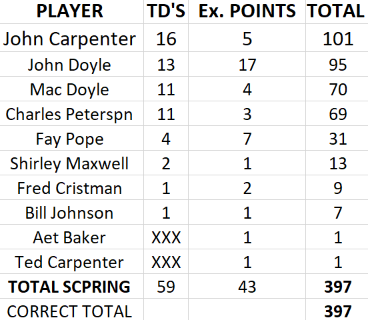
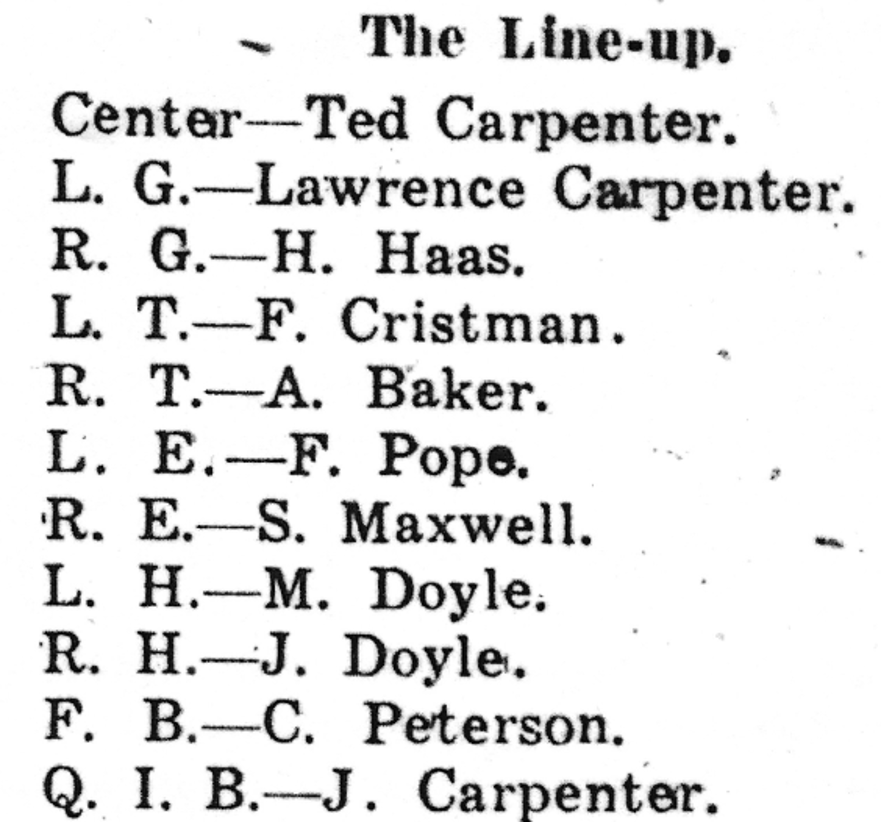
As stated, there was little mention of individual players in the game reports other than what I previously mentioned about scoring. What was mentioned in the final story on the team was that Ted Carpenter, Fay Pope, Shirley Maxwell, Mac Doyle, Art Baker, John Carpenter and Herman Haas were all seniors. I don’t know if any attended college as this was early on the Great Depression. What found was that a City Team was formed using some of the above listed seniors. The team was named the Spring Green Blues and as best as I could find was that the team went 9-1-0, playing other adult town teams and National Guard units. Having lost seven starters from the 1930 team coach Ellis directed his boys to a 7-1-0 record, scoring 220 points and allowed 37. They shutout four opponents, again lost the season opener to Richland Center and won their second Tri-County Conference title.
From 1928 through the 1936-37 school year Ellis’ Spring Green football teams won seven Tri-County Conference titles going 44-22-3. His basketball teams won five titles and the 1935 baseball team won the conference pennant. He retired in 1937 to go into farming near his hometown, Lancaster, but returned coaching to start the Oregon football program in 1941. While at Oregon he coached, in addition to football, basketball, boxing and baseball, and also taught science and served as the athletic director. A very busy man, indeed. Oregon played only a JV schedule, their first season of football after a 25-year hiatus. Tony then moved to Clintonville in 1942 coaching and teaching for the next 25-years. His overall football coaching record was 150-96-13. He was one of the original 22 coaches, two college coaches and two special contributors into the initial WFCA Hall of Fame in 1980.
And now, about Joesph Leo “Roundy” Coughlin? Born in 1889. “Roundy” was running a pool hall in Madison where his great ability to pick the winners of football games and boxing matches was noticed by the UW The Daily Cardinal newspaper. He once predicted correctly 155 out of 172 football and 48 of 50 basketball games. He then began to write for the Madison Capitol Times for $5 a week but their rival, The Wisconsin State Journal, noticed his talent and hired him away from the Times in1924. He was offered a full-time sports writing position with the paper which paid him a steady salary as well as a new automobile and announced his hiring with a full-page story about him on April 4, 1924.

The Capitol Times had sent his stories to other state papers and when Roundy moved to the Journal, he was known far and wide. He just got a bigger platform. A champion of underprivileged children through charity work, an expert in all sports and a friend to all. He would send Knute Rockne tips about upcoming opponents, and was a friend with boxers Jack Dempsy and Rocky Marciano, a proponent of bringing minor league baseball to Madison and so many other people that were everyday individuals as well as politicians. Roundy would write until 1970 for the Journal and was often compared to Walter Winchell in the 1940’s and 50’s. His writing was sometimes grammatically incorrect but copy editors didn’t dare make corrections. He meandered throughout his columns writing about many topics. At 6’0, 200 he was a big man not just in Madison. How did Joseph L. Coughlin get the nickname as Roundy? I thought it may have come from his time managing a pool hall but it may have just been earned as a youth because of his size. Roundy passed in 1971.
When doing research, a phrase from the movie Seabiscuit (2002) spoken by actor Toby McGuire playing jockey Red Pollard stated that is horse: “We may be small, but we are mighty”. That was Spring Green, 1930.


Comments